



Data Centres might be to modern infrastructure what railways were to the latter half of the 19th Century. On the surface that may well read like a slightly absurd statement, yet for a connected world where the digital economy, fueled by astounding levels of investment and innovation in AI, continues to transform how we do business, it’s not far off it. People and businesses are no longer connected by a standard gauge of 1435mm. It’s a 75mm cable in deep sea trenches instead.
Let’s stick with this comparison a moment longer because we’d like to reference Antwerp Centraal Station in Belgium. Widely considered one of the most beautiful railway stations in the world, with its three-hinged arches, it’s an architectural marvel that transcends its purpose. The same goes for St Pancras, Grand Central Terminal and Paris Gare de Lyon. Each provides a reason for visiting even if there is no intention of travelling.
Now, Data Centres are highly unlikely to ever have the general public queuing up to take in the delights of a room featuring row upon row of computer equipment. With the possible exception of people who enjoy wearing lanyards anyway. But just because a data centre isn’t going to get much foot traffic doesn’t mean it shouldn’t be architecturally interesting. Indeed, given most new data centres are located in rural or semi-rural areas, set against a backdrop of expansive countryside, maybe there’s even more need for them to be beautified so as to make sure they don’t ruin the vista.
We can certainly be sure there will be many more data centres, so whatever shape and form they take - there'll be a lot of them and they won’t be small. It’s estimated that nearly 100 GW of new data centres will be added between now and 2030, effectively doubling global capacity. Many of these will come in the form of Hyperscale Data Centres, such as those developed by AWS, Google Cloud Platform, Microsoft Azure, Alibaba Cloud, IBM, and Oracle. There'll be lots of smaller data centres also and while there’s obviously a shift towards building hyperscale data centres, we’re looking at nudging the physical number of buildings from just over 10,000 to closer to 20,000.
Much of this growth will come on the back of the current AI growth, a technology typified by data hungry programmes and astounding levels of computer power. It’s been described as an ‘infrastructure supercycle’ with up to US$1.2 trillion in real estate asset value creation, followed by an additional US$2 trillion in expenditure needed to fit out the spaces with IT equipment.
With so much expected growth, it’s too good an opportunity not to use architects for what they do best. Namely, taking something functional and making it beautiful. Also, we should note data centres aren’t universally welcomed by nearby residents for a myriad of reasons beyond the scope of this article. In which case, appeasing the opposers with a design of astounding architecture is no bad thing.
Apart from being made pretty, data centres also need to be made quiet. This can get tricky when data centres require cooling and just how that’s achieved can be moderately noisy. The need for cooling comes from all those whirring computers using the power needed for AI to create Hollywood feature films featuring a cast that’ll never bad mouth the director on the red carpet or turn up late and delay the shoot. This is because any time power is used, heat is created, and generally speaking, every megawatt of electricity consumed generates one megawatt of heat. It’s also because of ‘Moore’s Law’, which details how the number of transistors needed to achieve chip or clock rates in modern computers doubles every two years. And these transistors generate an amazing amount of heat density which can lead to high junction temperatures, which leads to failure and data centre downtime unless the equipment can be cooled.
Anyway, that cooling will come from liquid cooling, air cooling, free cooling, or a hybrid model that uses a combined approach, although we note the general industry move towards using more free cooling, such as direct air and adiabatic cooling. Yet with both, machinery is needed to ‘move the cool in and the hot out’. That machinery makes a noise. Of course, louvres can be used to let air in but they also tend to let the decibels out. That is unless acoustic louvres are used, like those from our sister-company, Ventuer.
The point to be made is to use Ventuer for acoustic louvres. On a more serious note, we’re pointing towards the need to consider the impact Data Centres have on anyone nearby, and if it’s close enough to residents for soundwaves to potentially escape into the air and into bedroom windows where they can annoy people, then the data centre is certainly close enough for it to be needed to be designed in such a way that it adds to the aesthetics of the area rather than detracts from it. On the flip side, even if the Data Centre is removed from any proximity to people, and the disturbance caused by noise is only to be felt by a nearby family of now-stressed possums, there’s still a need to dim the hum. Because wildlife genuinely does appreciate a lack of industrial noise as much as we do, otherwise it can interfere with reproduction and even alter their behaviour.
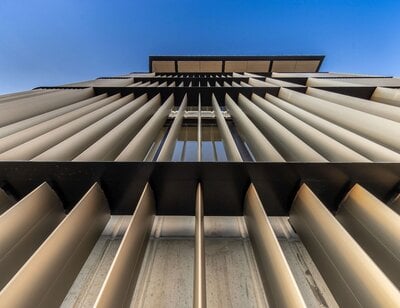
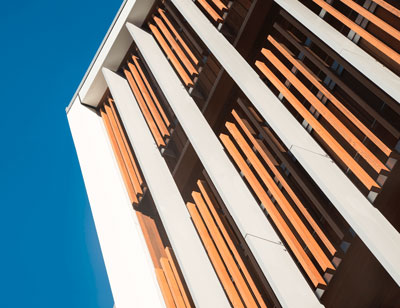
While we stated earlier that remote Data Centres need to be made attractive to blend in, so must those in more urban areas. In other words, it doesn’t matter where a Data Centre is located, there’s every reason to make it aesthetically pleasing, and we should remember that beauty and function aren’t antithetical. Of course, this is where we suggest the use of our services. There’s the obvious reasons why, such as the use of louvres to help control thermal gain, adding to the internal temperature control that’s so critical for Data Centre uptime. Equally obvious are the energy quenching benefits derived from louvres as they help lower the energy burden needed for mechanical air conditioning.
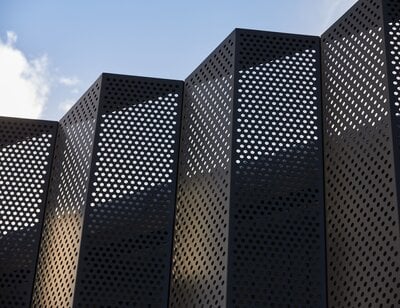
The less obvious reason why is the creative freedom aluminium facades offer. Here’s a canvas that can carry the most intricate and meaningful designs imaginable, that can be any colour, and that can remain in near-perfect condition after generations with only minimum maintenance.
It’s not just about making Data Centres pretty for the sake of aesthetics though. We know architecture plays an important role in ‘place identity’. We also know architecture can impact our feelings and even how we interact with each other (as a result of those feelings). So if there’s a need to make data centres appealing to the visual eye, there’s equally a case to be made for making them appeal to us emotionally, too. If Hyperscale Data Centres are to take up large swathes of land, and smaller Data Centres are to occupy inner City real estate, then they need to do more than exist functionally. Like the great train stations, they must also exist architecturally. And some of them already do.
The Amsterdam Data Centre doesn’t look anything like the rectangular building most think of. Designed by Rosbach Architects and AGS Architects, it’s a 72 meter high tower clad in bronze coloured panels that feature a triangular perforation. It’s impressive and wouldn’t look out of place in any built-up area.
Then there’s the structural stone design of the Evroc Data Centre in Sweden, to be built later this year. The silo-like form of the structure from Car Fredrik Svenstedt Architects is wholly original and looks more like some stone-age dwelling than a cutting-edge centre of technological wonder. Indeed, it’s not hard imagining people taking a detour to drive past to take a look at the structure. Imagine that - people driving to look at a Data Centre.
Maybe that’s what we should be aiming for. We know Data Centres are coming so now it’s time for a conversation about how we can make them as architecturally wonderful as they are technologically capable.
Like train stations. But different.