




Facades play a unique role in shaping place identity, providing a visual character that seeps into the collective conscience of residents and visitors alike. And at the all-important moment when attention and consciousness are at their peak, when first impressions that live long in the memory are formed, they set the tone for everything that follows.
Take Manhattan as an example. There’s an incredible feeling of urgency and concentrated ambition rising from the architectural palimpsest. It’s a place for moving on and moving ahead, as told by an architectural story that has brownstones beside glass towers, and art deco structures next to postmodern slabs. But before we detail how facades can influence and shape place identity, let’s take a step back and define the scope of the topic by defining place identity itself.
Place identity comprises the memories, feelings, and attitudes we hold towards a specific physical setting. In that regard, it’s not the tangible characteristics of the place as much as it’s our interpretation of them. This then informs our ‘sense of place’. Indeed, place identity and sense of place might be used interchangeably. Some literature even talks of facades in relation to urban identity, although that’s a bit of a stretch given urban identity is as much (if not more) about people and their collective lived experiences (history and culture) than place. Regardless of the words used and definition agreed, what cannot be denied is that each physical setting creates a cognitive reference point against which our feelings for a place are set. Central to that cognitive reference point are the facades.
Just how places build their visual identity, as expressed through their facades, varies considerably. The world's great Cities have developed their characters over centuries. London began to take shape around AD 47, although the oldest surviving buildings date back to around AD 1097, such as Westminster Hall (home to the Houses of Parliament) and the White Tower (also known as the Tower of London). That other iconic building, Big Ben, was a much later addition (1843), but it looks very much as if it was always there. These are the buildings that adorn tourists' trinkets and define not just the City, but Great Britain itself.
Of course, that’s only part of London’s story. The rest is told by the Georgian brick terraces of Soho, the grand Victorian facades of Kensington, and even the post-war modernism of the Southbank. They all anchor London’s place identity, informing visitors' opinions through a historical context missing in modern Cities.
Then there’s the famously British nod to social class. London is a class-coded City (and society), a point highlighted through the facade differences on display. Grand entrances and ornate facades abound around Mayfair, while the East End is decidedly working class, with narrow doors and simpler facade detailing. Viewed subconsciously, it builds a place identity unlike any other, becoming a version of London that differs from one person to the next, but also shows similarities. The city’s facades play a crucial role in this.
Of course, place identity can change over time and facades will help with this. So while there’s much truth to ‘the building knew itself following a higher public space and refrained individual asserting in favor of totality’ inasmuch as there is a need for the facade to speak of its time and place, it can also evoke new feelings through new design. Think of it this way, if the City is a story told through its architecture, then a new chapter progresses that story, moving it closer to an intentional future, and the result is a changing place identity.
Now, that all sounds rather abstract, so let's delve into how those changes are manifested through facade design. For example, the colour choice of facades is important. Buildings and their facades in Charleston, South Carolina, are known for their bright pastel colors. Take a walk down Rainbow Row and the colours invoke a feeling of cheerfulness. This was intentional and led by Dorothy Porcher Legge in the 1930s as she set about restoring the area.
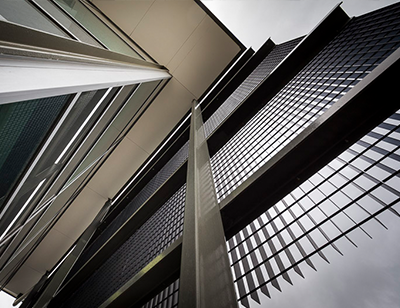
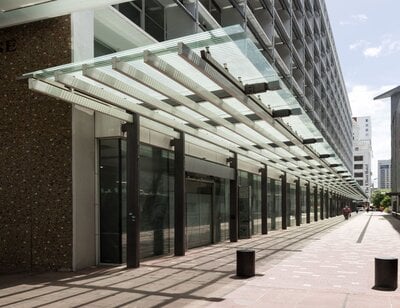
Shape is important too. Take the chamfered and squarebox louvre blades of our own Solaris louvres. Unapologetically modern, they’re commonly used on commercial buildings for shading, adding strong lines to the visual presence and making a statement.
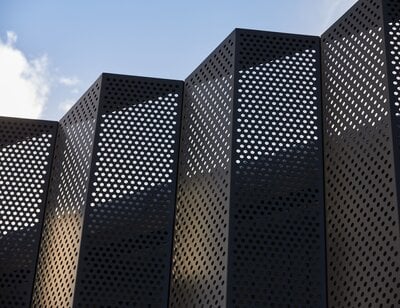
Elsewhere, dapple patterns are used to create a dancing interplay between sunlight and shadow. Their use can be almost poetical, adding a playfulness which appeals to creative, imaginative minds. Or when grounded in a local context, these patterns can be used to anchor the place identity and build upon the natural environment. For example, the Holiday Inn in Queenstown uses a custom dapple pattern as part of a design that mimics the landscapes and the glaciers that carved it many years ago. The result is a design that reinforces the sense of location, reaffirming the visitor's reasons for being there.
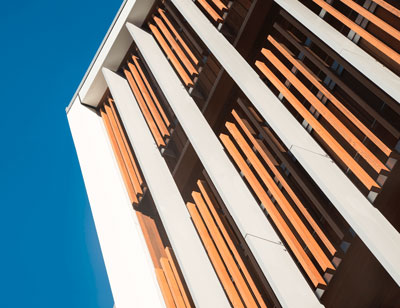
Another example is Country Club Huapai. Set in a semi-rural area, its gabled standing seam metal roofs trace a line from past to present. Standing out against the white backdrop are woodgrain louvres that feel more village than City, more comforting than imposing, and more welcoming than a natural aluminium finish. Those designed perceptions fit the purpose of the building, but they also fit the location of the building, and they both contribute to place identity.
And this is the point. Stand in front of a building and the facade will speak to you. Walk past multiple facades and they’ll tell you a story. That story will include a cultural narrative, historical context, and even a reflection of the character of the community. All of that builds up the ‘place identity’.